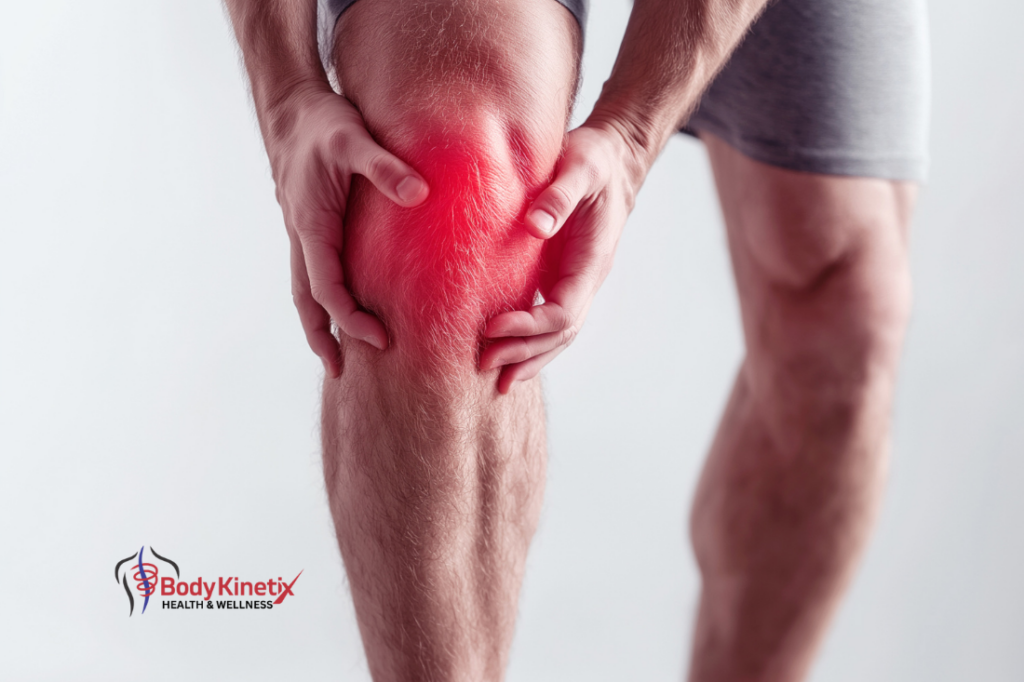
If you are an athlete, weekend warrior, or avid gym-goer, few things are more frustrating than a sharp, nagging pain right below your kneecap. Every time you jump, sprint, or even walk down a flight of stairs, your knee reminds you it’s unhappy.
This condition is widely known as Jumper’s Knee (medically termed patellar tendinopathy).
For years, the standard advice was to “rest it and ice it until it stops hurting.” But modern sports physiotherapy has flipped the script. If you want to permanently fix jumper’s knee, complete rest is actually the enemy.
Here is a look at what is happening under the kneecap and how modern physiotherapy can help you rebuild a resilient, pain-free tendon.
Jumper’s Knee: Inflammation or Something Else?
To fix the problem, we first have to understand it. While people often call it patellar tendonitis (implying inflammation), it is usually a tendinopathy.
The Reality Check: Jumper’s knee is rarely a swelling or inflammation issue. Instead, it is an overuse and under-capacity issue. Your patellar tendon has been asked to handle more mechanical load (from jumping, landing, or running) than it is currently strong enough to tolerate.
When a tendon is chronically overloaded, its internal fibers become disorganized. Resting it makes the pain go away temporarily, but it also makes the tendon weaker. The moment you return to your sport, the pain strikes again because the tendon’s capacity hasn’t changed.
The 4-Phase Physiotherapy Roadmap
Effective physiotherapy doesn’t just treat the symptoms; it progressively loads the tendon so it adapts, heals, and grows stronger. A gold-standard rehabilitation program generally moves through these four phases:
Phase 1: Calm It Down (Isometric Loading)
When your knee is highly reactive and painful, you don’t want to do explosive movements. However, completely stopping is a mistake. Instead, physios use isometrics (holding a position without moving).
- Why it works: Isometric exercises have an amazing “analgesic” (pain-relieving) effect on tendons while maintaining muscle activation.
- Key Exercises: Isometric wall sits (holding at a 45 to 60-degree angle) or single-leg leg press holds.
Phase 2: Build It Up (Heavy Slow Resistance)
Once the acute pain settles, it’s time to remodel the tendon fibers. The absolute gold standard here is Heavy Slow Resistance (HSR) training. Tendons love slow, heavy loads because it forces the disorganized collagen fibers to realign.
- Why it works: It builds bulk strength in the quadriceps and increases the mechanical threshold of the tendon.
- Key Exercises: Slow goblet squats, leg presses, or Bulgarian split squats (taking 3 seconds to go down, and 3 seconds to come up).
Phase 3: Spring It On (Energy Storage & Plyometrics)
A healthy tendon acts like a rubber band, it absorbs energy and snaps back. Once your knee can handle heavy weights slowly, your physio will reintroduce speed.
- Why it works: It trains the tendon to handle the dynamic “spring” required in sports.
- Key Exercises: Skipping, terminal acceleration/deceleration drills.
Phase 4: Return to Sport
The final stage is a structured, gradual return to your specific sport. Your physiotherapist will help you manage your weekly “loading budget” so you don’t spike your training volume too quickly and trigger a regression.
Looking at the Bigger Picture
A great physical therapist won’t just look at your knee; they will look at how your entire lower body moves. Jumper’s knee is often the result of compensation for weaknesses elsewhere:
| The Culprit | Why It Impacts the Knee |
| Weak Glutes & Hips | Causes the knee to collapse inward (valgus) during jumps, putting uneven stress on the patellar tendon. |
| Stiff Ankles | If your ankle dorsiflexion is limited, your body forces the knee to travel further forward to absorb shock, overloading the tendon. |
| Poor Landing Mechanics | Landing “stiff-legged” instead of absorbing force through the hips and glutes forces the knee tendon to take the brunt of the impact. |
Quick Summary for Recovery From Jumper’s Knee
- Don’t rely on complete rest. It weakens the joint long-term.
- Modify, don’t stop. Swap high-impact jumping for heavy, slow strength training.
- Pain is a guide, not a stop sign. A small amount of discomfort during rehab (around a 2 or 3 out of 10) is completely safe, provided it doesn’t feel worse the next morning.
- Be patient. Tendons take longer to heal than muscles because they receive less blood flow. A proper recovery can take anywhere from 6 weeks to several months.
Disclaimer: Every knee is unique, and this is general information. Before starting any rehabilitation protocol, ensure you get a thorough assessment from a qualified physical therapist to tailor a program exactly to your movement patterns and injury severity, and goals
If you are looking for a physiotherapy assessment in Mississauga, and want to have your knee pain safely addressed, book online with a Body Kinetix Health & Wellness team member or call us today!